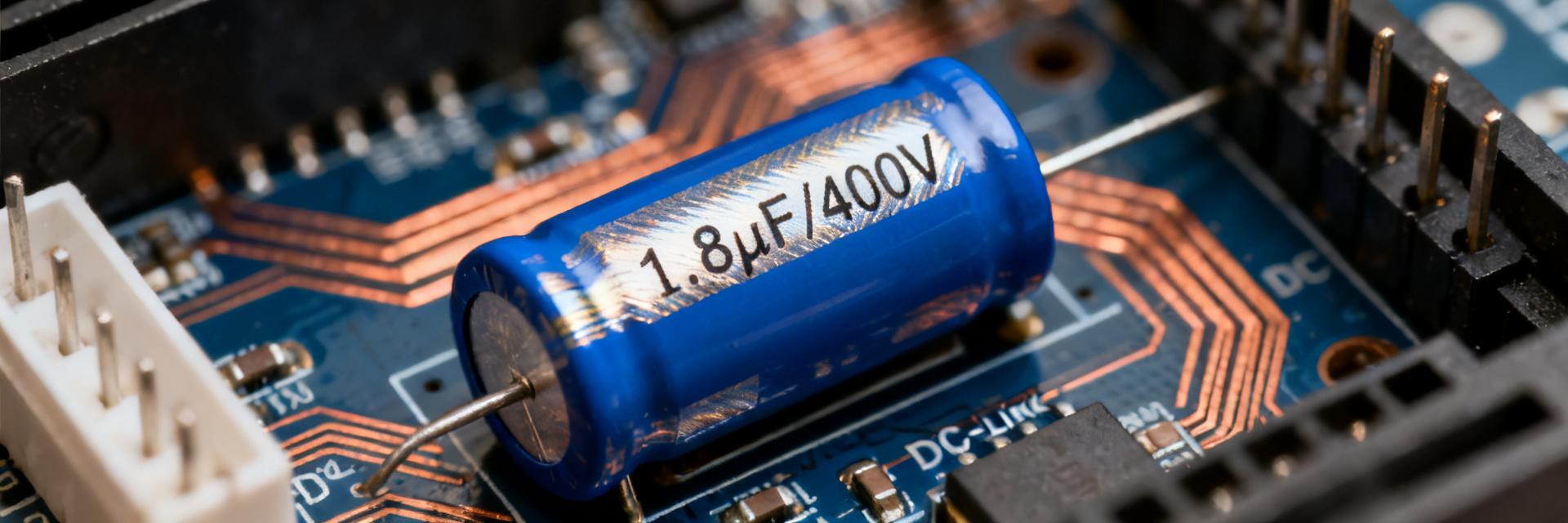
In power supply design and power electronics selection, film capacitors have become critical components for DC-Link, filtering, and snubber circuits due to their high voltage resistance, low loss, and self-healing properties. As a 1.8μF/400V metallized polyester film capacitor, the parameters and reliability of the ECQ-E4185KZ deserve a systematic interpretation. Through this article, you will master its core parameter logic, material advantages, and typical application boundaries, allowing you to make more robust engineering decisions during selection.
ECQ-E4185KZ Core Parameters at a Glance
Naming Convention and Parameter Decoding
The model number ECQ-E4185KZ itself is a concise technical specification. The ECQ series is positioned as metallized polyester film capacitors, where E4 represents PET dielectric, 185 represents 1.8μF, K represents ±10% tolerance, and Z corresponds to a 400V DC rated voltage. Understanding this naming logic allows you to quickly determine its basic applicable scenarios.
| Parameter | Specification Value |
|---|---|
| Capacitance | 1.8μF |
| Tolerance | ±10% |
| Rated Voltage | 400V DC |
| Operating Temperature Range | -40°C to +105°C |
| Dissipation Factor (tanδ) | ≤1.0% (1kHz) |
Compared with the same series ECQ-E4105KZ (1.0μF) and ECQ-E4225KZ (2.2μF), 1.8μF is an intermediate value, suitable for applications requiring a balance between ripple absorption and size control.
Design Meaning Behind the Parameters
The selection of 1.8μF in DC-Link and filter circuits is not arbitrary. It is directly related to the switching frequency and ripple current requirements: higher frequencies and larger ripple currents usually require higher capacitance. The ±10% tolerance has a clear impact on the accuracy of resonant and timing circuits, requiring you to reserve sufficient margin in your design.
For the 400V DC rated voltage, it is recommended that the actual operating voltage does not exceed 80% of the rated value, meaning the continuous operating voltage should be kept under 320V to extend service life and reduce the risk of dielectric breakdown.
Analysis of Film Capacitor Technical Characteristics
Material Advantages of Metallized Polyester Film
Polyester (PET) dielectric features a high dielectric constant, good volumetric efficiency, and moderate cost. The self-healing mechanism of metallized electrodes is a core advantage: after a localized breakdown, the electrode evaporates to isolate the fault, preventing permanent short circuits. Compared to polypropylene (PP) film capacitors, PET excels in capacitance density, but has slightly higher high-frequency losses, requiring a trade-off based on the operating frequency.
Electrical Performance and Reliability
The ECQ-E4185KZ features low ESR and high ripple current capability, making it suitable for SMPS output filtering. Insulation resistance and leakage current specifications guarantee long-term stability. Within the -40°C to +105°C range, the capacitance drift and loss trends are controllable. Since there is no electrolyte dry-out issue, it is suitable for long-term operation in high-humidity environments.
The self-healing characteristic of film capacitors allows them to restore insulation even after overvoltage breakdown, which is a reliability advantage not possessed by electrolytic capacitors.
Typical Application Scenarios of ECQ-E4185KZ
DC-Link and Output Filtering in Switching Power Supplies
In AC-DC and DC-DC converters, the ECQ-E4185KZ can serve as a DC-Link capacitor to absorb bus ripple and stabilize DC voltage. At the output, combining it with an inductor to form an LC filter network can effectively reduce output voltage ripple. During selection, it is crucial to verify the ripple current, estimate temperature rise, and optimize layout.
Snubbing and Coupling in Industrial Control and Consumer Electronics
In IGBT/MOSFET snubber circuits, it suppresses turn-off spike voltages to protect power devices. For signal coupling and decoupling, it is suitable for audio and intermediate frequency circuits. Typical application equipment includes inverters, UPS, LED drivers, and home appliance control boards.
Engineering Precautions in Selection and Use
Alternative Selection and Parameter Matching Principles
Capacitance and voltage rating must meet circuit requirements, and tolerance and temperature coefficient should match the original design. Confirm mounting style and pitch: through-hole and SMD have different application scenarios. Derating design recommends reducing voltage to 80% and keeping temperature below 85°C to extend lifespan.
Common Failure Modes and Mitigation Strategies
Surge voltages can lead to dielectric breakdown, requiring overvoltage protection using varistors or TVS diodes. When high-frequency ripple is too large causing overheating, verify if the ripple current is within the allowable range. During manual soldering, control temperature and time to avoid thermal damage.
Key Takeaways
- The ECQ-E4185KZ is a 1.8μF/400V metallized polyester film capacitor with a ±10% tolerance and an operating temperature range of -40°C to +105°C.
- The self-healing properties of the PET dielectric and low ESR make it suitable for DC-Link, output filtering, and snubber circuits.
- During selection, it is recommended to derate the voltage to 80%, control the temperature below 85°C, and verify the ripple current.
- Typical applications cover switching power supplies, inverters, UPS, and LED drivers.
Frequently Asked Questions
Can the rated voltage of 400V DC of ECQ-E4185KZ be used in AC circuits?
The 400V DC rating is not directly applicable to AC circuits. If used in AC, a derating evaluation must be conducted based on the AC peak voltage and frequency. Generally, it is recommended that the AC RMS value does not exceed 50% to 60% of the rated DC voltage, and the ripple current must be confirmed to be within the allowable range.
How does the capacitance of the ECQ-E4185KZ film capacitor change in high-temperature environments?
In the range of -40°C to +105°C, the capacitance of PET film capacitors increases slightly as the temperature rises, with the change typically within ±5%. Above 105°C, capacitance drift and loss will accelerate; therefore, it is recommended that the actual operating temperature does not exceed 85°C to maintain long-term stability.
How do I determine if the ECQ-E4185KZ is suitable for my DC-Link circuit?
You need to calculate the bus ripple current RMS value, switching frequency, and allowable voltage fluctuation. If the ripple current is within the capacitor's rated range and the operating voltage does not exceed 320V, the ECQ-E4185KZ is typically suitable. If the ripple current is large, it is recommended to connect multiple capacitors in parallel or choose a model with higher capacitance.
Can the ECQ-E4185KZ replace electrolytic capacitors for output filtering?
It can partially replace them, but you must pay attention to the difference in capacitance. Film capacitors typically have smaller capacitance than electrolytic capacitors, but they have lower ESR, longer lifespans, and are non-polar. You can use them to replace electrolytic capacitors in high-frequency filtering applications, or use a combination of film and electrolytic capacitors in parallel to balance large capacitance and high-frequency performance.