According to industry statistics, the global film capacitor market has now surpassed US$3.2 billion, while Japanese manufacturers' production shutdown notices are increasing at a rate of 3–5 models per month. As Panasonic Industrial's classic DC film capacitor product line, the ECQ-E series covers 80% of common applications—such as power supply filtering and coupling/decoupling—with capacitance values ranging from 68 nF to 4.7 μF. With the discontinuation of the ECQ-E series becoming an urgent need for engineers, how can one achieve seamless component selection while ensuring consistent electrical parameters? Based on the latest technical data, this article outlines a complete replacement roadmap and a decision-making framework for component selection.
Product Positioning and Background of the ECQ-E Series Discontinuation
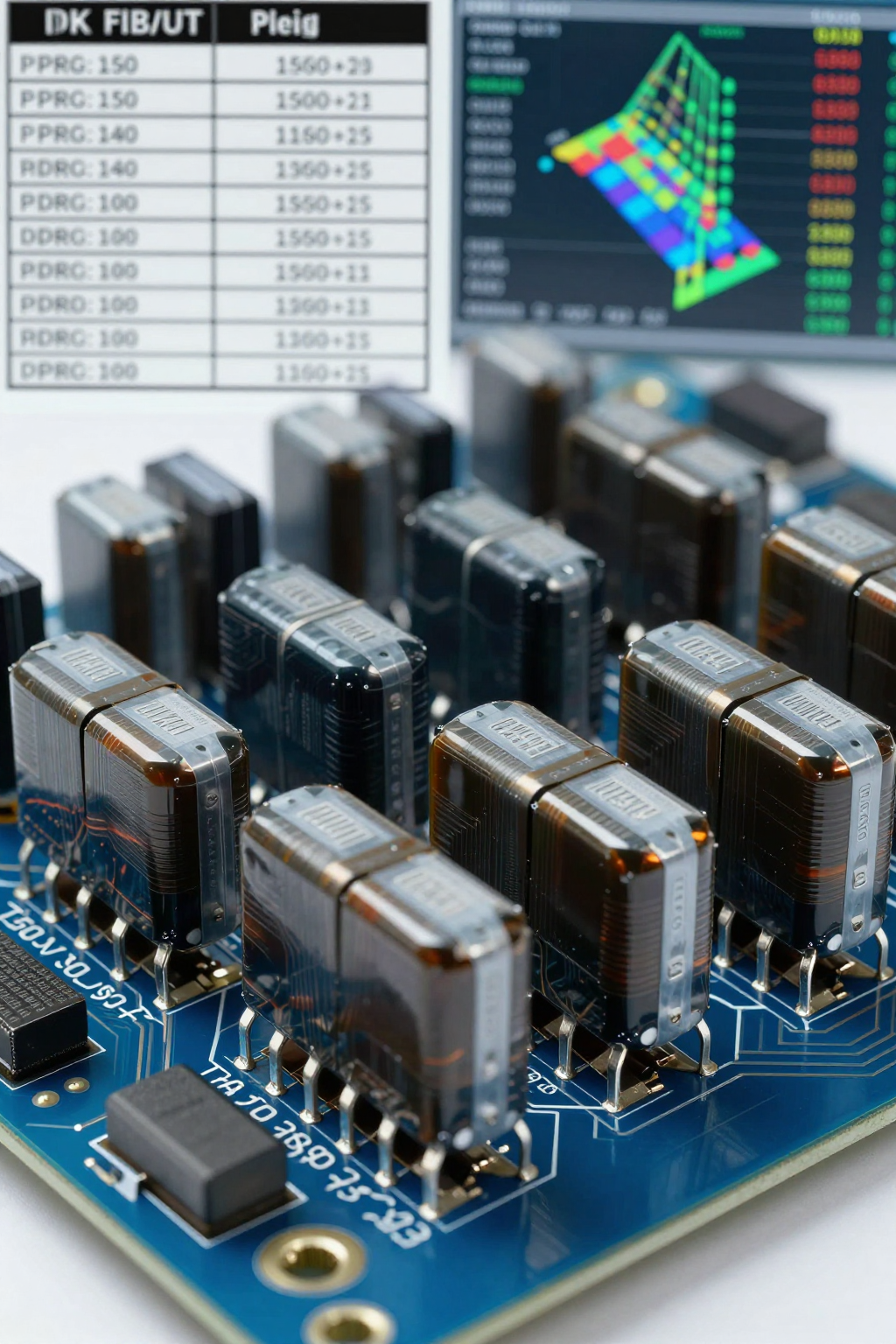
The ECQ-E series comprises metallized polyester film capacitors, with rated voltages ranging from 50 VDC to 630 VDC and an operating temperature range of -40°C to +105°C. Its key advantages lie in its self-healing properties and high volumetric efficiency, making it widely used in switching power supplies, inverters, and industrial control applications. This series features epoxy resin encapsulation and a radial lead configuration, with a typical lifespan of up to 100,000 hours under rated voltage and 85°C conditions.
Product Architecture and Key Parameter Characteristics
The ECQ-E series employs a wound metallized polyester film structure, with zinc-aluminum alloy vapor-deposited electrodes. Key parameters include: capacitance accuracy of ±5% (J tolerance) and ±10% (K tolerance), dissipation factor ≤ 1.0% (at 1 kHz), and insulation resistance ≥ 30,000 MΩ·μF. Package dimensions comply with EIA standards, featuring lead pitches ranging from 2.5 mm to 15 mm in graduated increments, ensuring flexibility for PCB layout requirements.
Discontinuation Timeline and List of Affected Specifications
Panasonic has officially placed the ECQ-E series under phase-out management, primarily affecting mainstream capacitance values such as 68 nF, 100 nF, 220 nF, 470 nF, 1 µF, 2.2 µF, and 4.7 µF. Low-voltage specifications (50 V–100 V) are being phased out first, while high-voltage specifications (250 V–630 V) will remain available for a relatively longer period. Engineers are advised to immediately verify the status of specific part numbers in their BOMs.ECQ-E4683KZand initiate the alternative evaluation process.
Parameter breakdown and substitution matching logic for the 68 nF to 4.7 µF range
The core challenge in selecting replacements lies in balancing electrical equivalence with supply chain availability. A three-dimensional mapping model of capacitance–voltage–size must be established to avoid system-level failure risks caused by single-parameter matching.
Three-dimensional mapping relationship among capacitance, voltage, and size
For example,ECQ-E4683KZTaking (68nF/630V) as an example, its package dimensions are 10.5mm × 5.0mm × 11.0mm (L×W×H). When selecting a replacement, prioritize locking the 630V voltage rating first, then ensure compatibility with lower capacitance tolerances. When replacing a high-voltage specification with a low-voltage one, verify that the dv/dt withstand capability meets the requirements of pulse-driven applications such as IGBT driving.
| Original Specification | Capacitance | Voltage | Typical Dimensions (mm) | Key Replacement Constraints |
|---|---|---|---|---|
| ECQ-E4683KZ | 68nF | 630V | 10.5×5.0×11.0 | dv/dt≥1000V/μs |
| ECQ-E4104KF | 100nF | 630V | 12.5×6.0×12.0 | Ripple current≥1.2Arms |
| ECQ-E4224KF | 220nF | 630V | 15.0×7.5×14.0 | ESR≤15mΩ@100kHz |
| ECQ-E4474KF | 470nF | 630V | 18.0×9.0×16.0 | Self-healing characteristic equivalent |
| ECQ-E4105KF | 1μF | 630V | 22.0×11.0×20.0 | Surge voltage ≥ 1.5 × Un |
| ECQ-E4225KF | 2.2μF | 630V | 26.0×13.0×24.0 | Thermal resistance θja ≤ 35℃/W |
| ECQ-E4475KF | 4.7μF | 630V | 32.0×16.0×30.0 | Frequency characteristic matching |
Key electrical characteristics comparison: ESR, ripple current, temperature characteristics
Metallized polyester (PET) and metallized polypropylene (PP) films have fundamental differences in their electrical characteristics. PET has a dielectric constant εr≈3.3, making it suitable for high capacitance density; PP has εr≈2.2 but lower losses (tanδ≤0.1% @ 1 kHz). When selecting replacements, key considerations include: the ESR frequency response curve, the temperature derating factor for rated ripple current, and the capacitance temperature coefficient (PET: +5% to +10%, PP: -2% to +2%).
Comprehensive Comparison Table of Discontinued Alternatives for the ECQ-E Series
Replacement paths are divided into two main routes: upgrades within the same manufacturer and equivalent replacements across manufacturers. Decisions should be made comprehensively based on certification requirements, cost constraints, and delivery schedule priorities.
Intra-manufacturer upgrade path: ECQ-E(F) series and ECW-FG series
Panasonic's preferred internal upgrade series is the ECQ-E(F), which features enhanced metallized electrodes and improved moisture resistance, capable of withstanding conditions up to 85°C/85% RH. The ECW-FG series, designed for automotive-grade applications, is AEC-Q200 certified and operates over an extended temperature range of -55°C to +125°C. An advantage of using equivalent alternatives from the same manufacturer is package compatibility, with pin pitches and mounting hole positions remaining fully consistent.
Cross-manufacturer equivalent substitution: Japanese, Taiwanese, and domestic Chinese solutions
For Japanese alternatives, options include ELNA's RE3 series or Nichicon's QYX series, which have highly similar electrical parameters but experience significant lead time fluctuations. Taiwanese manufacturers such as Farad Electronics' CBB21 series offer notable cost-performance advantages and have already entered the photovoltaic inverter supply chain in large volumes. Among domestic substitution solutions, metallized polyester film capacitors from Xiamen Farad and Tongfeng Electronics have passed IEC 60384-14 certification, with capacitance values ranging from 68 nF to 10 μF, making them suitable for cost-sensitive applications.
| Substitution Level | Representative Series | Certification Status | Relative Cost | Typical Lead Time |
|---|---|---|---|---|
| In-house Upgrade | ECQ-E(F)/ECW-FG | AEC-Q200 Optional | Benchmark | 12–16 weeks |
| Japanese equivalent | ELNA RE3/Nichicon QYX | UL/VDE | +15%~25% | 20–26 weeks |
| Taiwanese alternative | Farad CBB21 | IEC 60384-14 | -20%~30% | 8-12 weeks |
| Domestic substitution | Tongfeng/Xiamen Farah | CQC/GB | -35%~50% | 4-8 weeks |
One-click selection decision process and verification key points
A systematic selection method can shorten the evaluation period from several weeks to just a few days, with the core being the establishment of a quantifiable screening funnel.
Four-step screening method: from specification matching to sample verification
Step 1: Hard Parameter Screening——Identify three non-negotiable criteria: capacitance tolerance, rated voltage, and maximum size;Step 2: Electrical Soft Matching——Compare ESR-frequency curves, ripple current ratings, and dv/dt capability;Step 3: Environmental Adaptability Verification——Conduct high-temperature aging, temperature cycling, and humidity bias tests;Step 4: System-Level Confirmation——Re-test EMC conducted/radiated emissions, compare efficiency curves, and verify temperature rise distribution.
Common Selection Pitfalls and Avoidance Strategies
Typical pitfalls include: overlooking the capacitance degradation characteristics under DC bias (the DC bias coefficient of metallized film capacitors can reach -5%), confusing the frequency definitions of rated ripple current (100 Hz vs. 100 kHz), and underestimating the impact of pin pitch tolerances on automated insertion. It is recommended to establish an alternative verification checklist, mandating at least a review of 2,000 hours of accelerated aging data.
Practical Recommendations for Inventory Management and Supply Chain Transition
The final implementation of end-of-life product replacements involves inventory clearance, supplier onboarding, and coordinated transitions within the quality system.
Inventory Clearance and BOM Hierarchical Substitution Strategies
It is recommended to adopt a three-tier BOM architecture: Tier A retains the original part number for maintaining certified products; Tier B uses pre-certified alternative part numbers for new design introductions; and Tier C maintains a reserve of secondary alternative sources to address supply chain fluctuations. For inventory management, prioritize consuming high-availability specifications (100 nF, 470 nF, 1 μF), while lower-availability specifications (68 nF, 4.7 μF) can be handled through supplier buyback or resale channels.
Certification Cycle and Cost Control for New Supplier Onboarding
The typical onboarding cycle for industrial-grade components is 8–12 weeks, whereas automotive-grade components require 16–24 weeks. The cost model should include: sample fees ($200–$500), certification testing fees ($3,000–$8,000), and initial small-batch validation costs ($5,000–$15,000). It is advisable to sign capacity reservation agreements with alternative suppliers to secure priority supply during key quarters in 2025.
Key Summary
- Three-dimensional parameter mapping: For the ECQ-E series, when selecting replacements, it is necessary to simultaneously verify capacitance accuracy, rated voltage, and package dimensions. When high-voltage specifications are backward compatible, special attention should be paid to verifying dv/dt withstand capability.
- In-house priority strategy: The ECQ-E(F) and ECW-FG series maintain pin compatibility, which can minimize PCB revision risks. In automotive-grade applications, AEC-Q200 certified versions should be prioritized.
- Cross-manufacturer gradient: Japanese equivalents are suitable for high-reliability scenarios, while Taiwanese or domestic alternatives offer significant advantages in cost and delivery time. It is recommended to establish a dual-source backup system.
- Verification is indispensable: 2000-hour accelerated aging tests and system-level EMC retesting are essential steps in replacement certification, and a four-step screening method can effectively shorten the evaluation cycle.
- Supply chain resilience: Component supply chain volatility will intensify in 2025. It is recommended to complete the qualification and certification of at least two qualified suppliers, covering the full range of specifications from 68 nF to 4.7 μF.