
In a field failure analysis of industrial power modules, engineers discovered that Panasonic ECS-F1HE475K (4.7µF/50V) tantalum capacitors on multiple boards suffered short-circuit failures at the moment of system power-on. This article provides an in-depth analysis of their limitations and offers reliable replacement solutions based on the failure mechanisms.
In-depth Review of Failure Case: What Happened on Site?
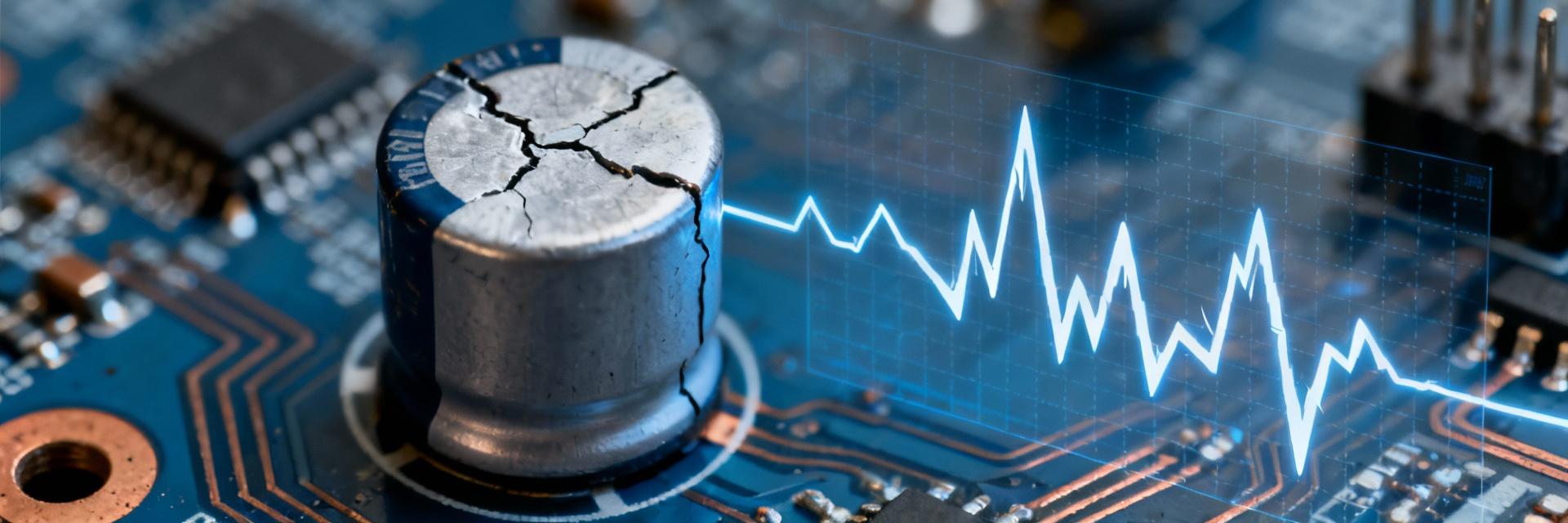
This case originated from a 24V to 5V DC/DC power module supplying a servo driver. During burn-in testing after mass production, some modules experienced no-output failures upon startup, with a failure rate of approximately 0.5%.
Failure Background: Application Scenario and Circuit Environment Analysis
The failed ECS-F1HE475K was located at the input filter position of the module, directly connected in parallel across the 24V input. Circuit analysis showed that the front end of the system lacked effective soft-start or surge suppression circuits. In actual factory environments, due to the starting and stopping of high-power equipment, input ports are highly susceptible to coupling high-voltage spikes with widths of tens of microseconds and amplitudes far exceeding the rated voltage.
Failure Phenomenon: Physical Damage under EM and Root Cause
Decapsulation and Scanning Electron Microscopy (SEM) analysis of the failed capacitors revealed obvious breakdown channels between the tantalum anode block and the manganese dioxide cathode layer, a typical "avalanche" failure. The root cause points to irreversible lattice structure changes in the manganese dioxide cathode when the capacitor is subjected to transient overvoltages far exceeding its rated surge voltage capability, leading to a sharp increase in leakage current and ultimate thermal breakdown.
ECS-F1HE475K Datasheet Interpretation and "Ideal" Discrepancy
Re-evaluating Key Parameters: Rated Voltage, Surge Voltage, and ESR
Reviewing the official manual for this model, a nominal 50V rating for a 24V circuit seems to provide more than double the voltage margin. However, the transient surge voltage of manganese dioxide cathode tantalum capacitors is typically only 70% of the rated voltage. This means a 50V rated model may actually withstand a surge voltage of only 35V. Additionally, while low ESR is beneficial for filtering, it can lead to higher instantaneous inrush currents during transient overvoltages.
"Shortcomings" Not Explicitly Stated in Data Sheets: Tolerance to Transient Overvoltage
Data sheets are usually based on steady-state test conditions, whereas dynamic stresses such as voltage transients, reverse peaks, and ringing in real applications are far more severe. Manuals often lack detailed curves regarding the tolerance for repetitive pulse overvoltages, which is precisely the root cause of many selection errors.
Tantalum Capacitor Failure Mechanism: Why are High-Voltage Transients the "Killer"?
The "Avalanche" Effect of Manganese Dioxide Cathodes
The semiconductor characteristics of manganese dioxide (MnO₂) dictate that its resistivity drops exponentially as the electric field increases. Transient overvoltages trigger a surge in local current density, generating Joule heat and forming positive feedback, which ultimately leads to localized thermal runaway within microseconds.
Voltage Derating: Gap Between Theory and Practice
The industry generally recommends a 50% voltage derating. However, facing high-frequency, high-energy transient shocks, even derating to 35V may be insufficient. In environments with significant surges, it is recommended to limit the operating voltage to 30%-40% of the rated value.
Core Principles for Tantalum Capacitor Selection under High-Voltage Transient Conditions
-
1
Principle One: Selection Based on Voltage Derating Ratio
Core Principle: The maximum possible transient peak voltage in the circuit (including all ringing and spikes) must be lower than the capacitor's rated surge voltage. Precise measurement with an oscilloscope is recommended. -
2
Principle Two: Series Resistance and Circuit Impedance Requirements
Connecting a small current-limiting resistor (0.5Ω to several Ω) in series within the charge/discharge loop can significantly suppress transient inrush currents.
Practical Replacement Solutions: More Than Just Changing a Model
📌 Key Summary
- Transient overvoltage is the root cause of failure: Do not just look at the static rated voltage; high-voltage transient spikes in the circuit are the primary killers.
- Derating rules must be applied dynamically: Ensure the capacitor's rated surge voltage is higher than the measured maximum circuit peak, leaving sufficient margin.
- System solutions are better than simple replacements: Prioritize system-level protection measures like snubber circuits and current-limiting resistors.