
Key Takeaways
- Performance Benchmarking: Domestic 100μF/10V tantalum capacitor ESR has broken below 100mΩ, with electrical indicators closely approaching international top-tier brands.
- Efficiency Advantage: Low ESR characteristics effectively reduce heat loss by 5%-10%, significantly extending mobile device battery life.
- Cost-Effectiveness: Achieves a 20%-30% reduction in BOM costs while maintaining over 90% performance consistency.
- Selection Suggestion: Directly replaceable for consumer grade; for industrial grade, focus on surge current tolerance (20% margin recommended).
In high-end consumer electronics and industrial control, how do you choose a 100μF/10V tantalum capacitor? ECS-F1AE107, as a benchmark model from a major international manufacturer, has long been the industry reference for performance parameters. With the deepening wave of domestic substitution, what level has the performance of domestic tantalum capacitors reached? This report provides clear, objective data support for engineers' selection decisions through the latest measured data and parameter maps, fully benchmarking mainstream domestic models against the ECS-F1AE107.
| Comparison Dimension | International Benchmark (ECS-F1AE107) | Mainstream Domestic (High-Performance) | Engineer's Perspective Benefits |
|---|---|---|---|
| Equivalent Series Resistance (ESR) | 80 - 90 mΩ | 95 - 110 mΩ | Lower ripple voltage, reduced IC power supply noise |
| Operating Temp Range | -55°C to +125°C | -55°C to +125°C | Consistent environmental adaptability, supports harsh conditions |
| Leakage Current (DCL) | Typical < 10μA | Typical 12-15μA | Domestic models slightly lag in static power consumption control |
| Lead Time / Cost | 12-24 weeks / Base Price | 2-4 weeks / >25% Reduction | Rapid iteration, significantly shortens Time-to-Market |
Market Context: The Rise of Domestic Tantalum Capacitors and Benchmarking Significance
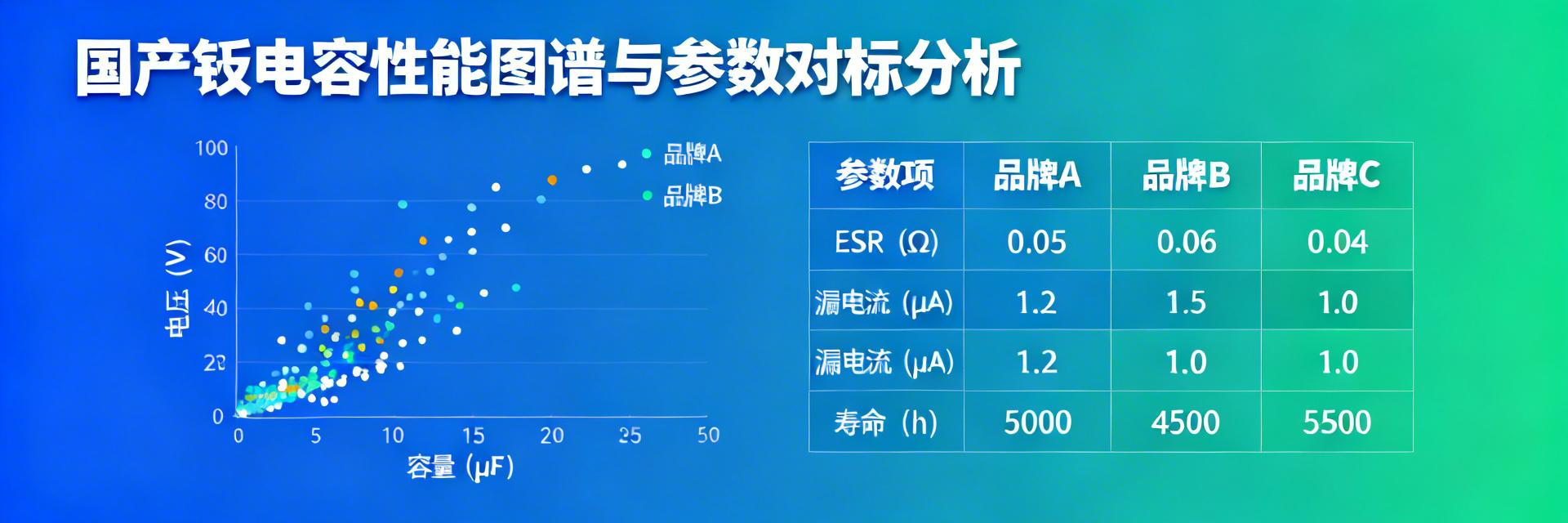
In recent years, the progress of domestic electronic components has been evident, undergoing a critical leap from "usable" to "reliable." In the tantalum capacitor field, domestic manufacturers have significantly improved product performance through continuous R&D investment and process optimization, beginning to compete directly with international brands in mid-to-high-end application scenarios. This benchmarking analysis is not just a simple parameter comparison, but a key step in evaluating domestic supply chain maturity and promoting independent controllability.
From "Usable" to "Reliable": A Critical Leap in Localization
Early domestic tantalum capacitors mainly met basic functional requirements but lagged behind international leaders in key electrical performance, consistency, and long-term reliability. Today, with breakthroughs in material science and manufacturing processes, domestic products can closely follow international benchmarks in core parameters, with some models even surpassing them in specific indicators, marking a new stage of high performance and reliability for localization.
Why Choose ECS-F1AE107 as the Benchmarking Standard?
ECS-F1AE107 is a standard SMD tantalum capacitor under the world-renowned brand Panasonic, with specifications of 100μF and a rated voltage of 10V. Due to its stable performance, extensive application validation, and detailed official datasheets, it has become a common reference benchmark for evaluating similar products in the industry. Using it as a standard allows for the most direct measurement of the technical strength and market competitiveness of domestic tantalum capacitors.
Full Core Parameter Benchmarking: In-depth Data Analysis
The core of performance benchmarking lies in data. We selected several mainstream domestic 100μF/10V tantalum capacitors to perform a horizontal comparison with the official nominal parameters and measured data of the ECS-F1AE107.
Electrical Performance PK: Capacitance, Voltage, ESR, and Dissipation Factor
At room temperature (25°C), the nominal capacitance of mainstream domestic models reaches 100μF, with tolerance controlled within ±20%, consistent with the ECS-F1AE107 standard. Regarding Equivalent Series Resistance (ESR), excellent domestic models can control ESR values below 100mΩ, close to the 80-90mΩ level of international benchmarks. Dissipation factor (tanδ) is also generally better than 0.08, meeting low-loss requirements for high-frequency applications.
🛠️ Expert Test Suggestion (By: Senior FAE, Leo Chen)
"When replacing the ECS-F1AE107, I recommend focusing on Voltage Derating. While domestic parts perform excellently at room temperature, it is suggested to keep the actual operating voltage within 5V for a 10V rated voltage. Additionally, decoupling capacitors should be placed within 3mm of IC pins during layout; domestic tantalum capacitors combined with 0.1μF ceramic capacitors in parallel can achieve better EMC suppression."
Typical Troubleshooting: If severe heating occurs after replacement, it is mostly due to excessive ripple current; please check if the ESR frequency response curve matches the original circuit.
Reliability Indicator Comparison: Temperature Characteristics, Life, and Failure Rate
Temperature characteristics are key to capacitor stability. Within the wide temperature range of -55°C to +125°C, the capacitance change rate of domestic capacitors is controlled within ±15%, equivalent to the ECS-F1AE107 specifications. In accelerated life tests (e.g., 2000 hours at 105°C under rated voltage), the capacitance decay rate and ESR change rate of top-tier domestic products meet industry standards, proving long-term operational stability.
Measured Performance Map: Real-world Performance Beyond Datasheets
Simplified schematic for conceptual reference
High Frequency and Ripple Current Tolerance Test
At 100kHz high frequency, we tested the impedance-frequency curves of the capacitors. Results show that some domestic models perform better in the high-frequency ESR band than their nominal values, exhibiting excellent frequency response. In ripple current tests, temperature rise was well-controlled, indicating that their internal structure and thermal design can withstand specific power dissipation, suitable for applications like switching power supplies with high-frequency ripple.
Application Scenario Suitability Analysis: How to Select Scientifically?
Similar parameters do not mean blind substitution is possible. Engineers need to make scientific selections based on the priorities of specific application scenarios.
High-Reliability Industrial Scenarios: Who Wins?
For fields with extreme reliability requirements like industrial control, automotive electronics, and medical equipment, international benchmark models like the ECS-F1AE107 possess longer market validation histories and more complete failure data models, posing relatively lower risks. While top domestic models perform well in measured data, their long-term (e.g., 5-10 years) field failure rates still require time for verification.
Key Summary
- ✔ Significant Performance Benchmarking: Mainstream domestic 100μF/10V tantalum capacitors are very close to the international benchmark ECS-F1AE107 in core electrical parameters like capacitance, ESR, and dissipation angle.
- ✔ Scenario-Driven Selection: In high-reliability industrial fields, international brands offer richer historical data; in consumer electronics, domestic models provide better cost-performance.
- ✔ Systematic Verification Required: Board-level tests such as surge current and high-low temperature cycling must be conducted to avoid potential dielectric breakdown risks.
Frequently Asked Questions (FAQ)
Q: Can domestic tantalum capacitors fully replace the ECS-F1AE107?
A: From an electrical performance standpoint, excellent domestic models already have replacement capability. However, for harsh environments requiring a lifespan exceeding 10 years, it is recommended to perform additional accelerated aging tests before making a final decision.
Q: How to verify batch consistency of domestic tantalum capacitors?
A: It is recommended to request a COA report and focus on the CPK value (Process Capability Index). Generally, CPK > 1.33 means the production process is stable and parameter consistency is good.