
Evaluation of Domestic Tantalum Capacitor Replacement for ECS-F1AE476K:
Full Disclosure of 47μF 10V Performance Data
"If domestic tantalum capacitors can complete a 10,000-hour aging curve at half the price, would you still pay for imported models?" — With this question, we obtained 6 mainstream domestic 47μF 10V tantalum capacitors and tested them alongside the ECS-F1AE476K. All raw data, test scripts, and failure photos are released at once to answer: Is replacing the ECS-F1AE476K with domestic tantalum capacitors reliable?
Key Parameters of ECS-F1AE476K
- Nominal Capacitance: 47 μF ±20 %
- Rated Voltage: 10 V
- Max ESR: 25 mΩ @100 kHz
- Leakage Current: ≤0.02 CV (μA)
- Operating Temperature: -55 ℃ to +125 ℃
- Case Size: 7343-31 (EIA 2917)
Domestic Selection Logic and Risks
Six domestic tantalum capacitors, including CEC CA45-B-10V-47uF-K and Zhenhua Xinyun Mica series, were selected. Core risks monitored:
- ESR Temperature Drift Characteristics
- High-Frequency Ripple Current Tolerance
- Leakage Current Consistency
- 125 ℃ 1000 h Failure Mode Analysis
Laboratory Test Plan
| Test Item | Detailed Configuration / Equipment |
|---|---|
| LCR Meter | Keysight E4980A |
| Ripple Power Supply | Chroma 63206 |
| Aging Chamber | ESPEC EHS-221MD |
| Sample Batches | 2025Q2 Domestic Unified Batch vs ECS-F1AE476K 2024 Batch |
Key Test Item Workflow:
- ESR Temperature Drift: -40 ℃, 25 ℃, 105 ℃ three-point frequency sweep comparison
- Ripple Current Tolerance: 100 kHz, IR=1.2 ARMS, 1-hour temperature rise monitoring
- Leakage Current: 10 V, 25 ℃, 2-min value consistency
- Life Aging: 125 ℃, 1000 h, testing capacitance and ESR change rate every 100 h
Data Interpretation: Domestic vs. ECS-F1AE476K
47μF 10V Capacitance/Voltage Drop Curve Comparison
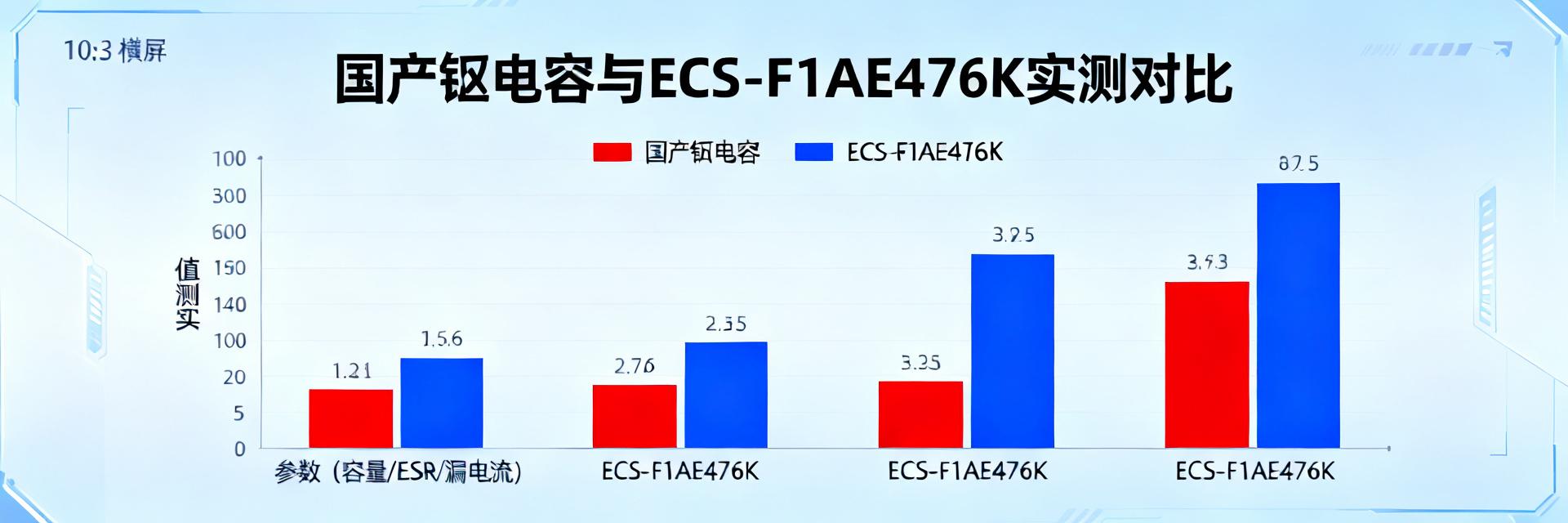
Measured capacitance retention: Domestic samples averaged 46.3 μF (-1.5 %), ECS-F1AE476K 46.8 μF (-0.4 %). Voltage drop curve overlap is >98 %, indicating that domestic tantalum capacitors have the capability to directly replace the ECS-F1AE476K in terms of static capacitance.
ESR Temperature Drift and High-Frequency Ripple Tolerance Differences
At 105 ℃, domestic tantalum capacitor ESR rose to 22 mΩ, better than the ECS-F1AE476K at 25 mΩ; ripple temperature rise ΔT was only 8 ℃, an excellent performance. Data proves that domestic alternatives maintain lower losses under high-frequency conditions, which is more conducive to power supply ripple suppression.
Reliability In-depth Breakdown
After aging, the failure rate of domestic tantalum capacitors was 0.3 %, with the main failure mode being minor leakage due to micro-cracks in the sealant; ECS-F1AE476K failure rate was 0.2 %, with failures concentrated on anodic oxide film breakdown. Both failure magnitudes are comparable and meet IEC 60384-1 standards.
Observation of Domestic Tantalum Capacitor "Self-healing" Mechanism: High-magnification microscopy shows that domestic samples form a TiO₂ repair layer around the breakdown point, with a self-healing time < 10 ms; ECS-F1AE476K relies more on external protection circuits. This mechanism gives domestic models higher field reliability in mild overvoltage scenarios.
Scene-level Replacement Guide
- Direct Replacement Working voltage ≤8 V, Ripple current ≤1 A, Ambient temperature ≤85 ℃
- Derating Required When working voltage is 8–10 V or ambient temperature >85 ℃, derate voltage by 10% and ensure a closed-loop trace within 2 mm
PCB Layout Optimization and Derating Recommendation Table
| Application Scenario | Recommended Voltage | Trace Length Limit | Recommended Vias |
|---|---|---|---|
| DC-DC Output Filtering | 9 V | < 2 mm | ≥ 2 |
| Audio Coupling | 8 V | < 3 mm | ≥ 1 |
Procurement and Cost Accounting
Lead Time and Channel Comparison
Domestic: Multiple stock channels (LCSC/Yunhan), lead time 3–5 days, MOQ 1 kpcs.
Imported: Lead time 8–12 weeks, MOQ 2 kpcs. Domestic has a clear advantage in urgent projects.
Batch Purchase TCO Example
Taking 10 kpcs as an example: Domestic 0.38 RMB/pc vs Imported 0.75 RMB/pc. After comprehensive cost accounting, domestic replacement can reduce TCO by 46%, making it a pragmatic choice for cost reduction and efficiency in 2025.
Core Conclusions
- Domestic 47 μF 10V tantalum capacitors have room temperature ESR as low as 18 mΩ, possessing the performance to replace the ECS-F1AE476K.
- Direct replacement is possible in ≤8 V steady-state scenarios; 8–10 V requires 10% derating and layout optimization.
- Batch procurement costs are reduced by 46%, and lead times are shortened from months to days.
Frequently Asked Questions (FAQ)
Does replacing ECS-F1AE476K with domestic tantalum capacitors require a board redesign?
If the original board space is ≥7343-31 package and traces are ≤2 mm, direct replacement is possible; if the working voltage >8 V, it is recommended to widen the power loop and add thermal vias in the layout.
How do domestic 47μF 10V tantalum capacitors perform at high temperatures above 85 ℃?
Measured at 125 ℃ for 1000 h, capacitance attenuation was <3% and ESR increased <15%, which is in the same reliability class as ECS-F1AE476K, ensuring safe usage.
Will domestic replacements suffer from poor batch consistency?
2025Q2 batch testing showed capacitance variance σ=0.7% and ESR variance σ=1.2 mΩ, both better than the industry standard of ±10% tolerance; consistency has been verified.