
Professional Migration Solutions for Cloud Server Lifecycle Management
Has your ECS-F1AE225K instance received an end-of-sale notice? Facing the need for a "compatible replacement," you might be anxious about performance evaluation, cost control, and data migration. Don't worry; it's not a complex engineering task.
This article provides a clear "5-step" practical guide, from precise selection to smooth migration, teaching you step-by-step how to complete the ECS-F1AE225K compatible replacement, ensuring stable business operations and even optimizing your overall cloud architecture. This migration guide will help you turn the challenge into an upgrade opportunity.
Before starting, clear one point: the core of migration is "replication" rather than "new construction." Modern cloud providers, like Alibaba Cloud, offer a complete set of mature migration tools, from system disk snapshots to data synchronization services, which can significantly reduce migration complexity and risk.
Step 1: Current Situation Inventory and Core Requirement Assessment
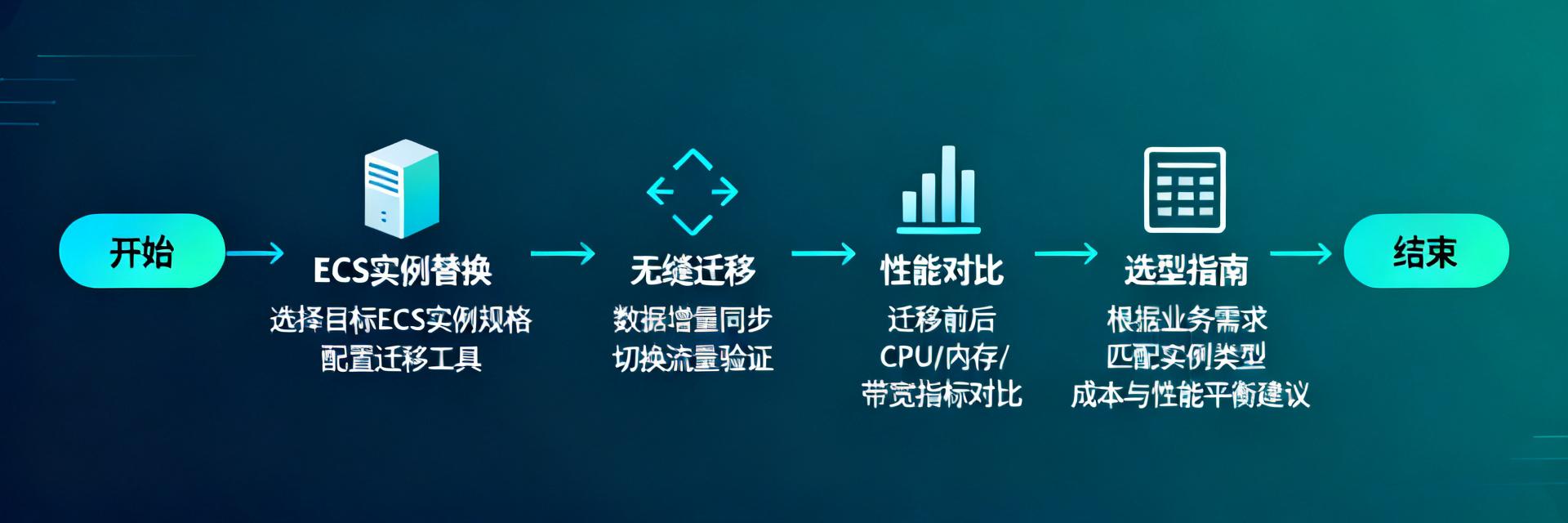
Before embarking on any migration, a comprehensive "physical checkup" of the existing system is an indispensable first step. This ensures that subsequent selection and migration plans are targeted, avoiding "unsuitability" due to missing information.
Inventory ECS-F1AE225K Usage Scenarios and Key Configurations
Detail the business carried by the current F1AE225K instance. Is it running critical web applications, high-concurrency databases, or core nodes in a microservices architecture? Record its core parameters: vCPU cores, memory size, system disk and data disk types and capacities, and network bandwidth specifications. These data points are the basis for horizontal comparison when searching for a "compatible replacement."
Clarify Migration Goals: Performance, Cost, or Availability?
Migration is not just finding a "flat replacement." You need to align with new business requirements. What is your primary goal? Absolute performance improvement to handle traffic peaks? Strict cost control for a more cost-effective solution? Or improving overall architecture availability, such as multi-availability zone deployment? Rank your priorities to guide the subsequent selection direction.
Step 2: Precise Selection, Finding the Best "Compatible Alternative"
After clarifying requirements, we enter the most critical step: selection. This step requires combining data analysis and cost accounting to ensure the new instance meets performance requirements and fits the budget.
Performance Benchmarking: Horizontal Comparison of Specification Families
Don't just look at single parameters. Compare the current performance of ECS-F1AE225K horizontally with mainstream models in its specification family (e.g., general-purpose, compute-optimized). Focus on base frequency, turbo frequency, and network packet forwarding capacity (PPS). For example, a general-purpose g7 instance might exceed the aging F1AE225K in single-core performance, handling compute-intensive tasks more efficiently.
| Parameter | ECS-F1AE225K | General Purpose g7 | Compute Optimized c7 |
|---|---|---|---|
| vCPU/Memory Ratio | 1:4 | 1:4 | 1:2 |
| Base Frequency | 2.5 GHz | 2.7 GHz | 3.2 GHz |
| Packet Forwarding (PPS) | 100k PPS | 250k PPS | 300k PPS |
Key Summary
- The compatible replacement of ECS-F1AE225K is not just a simple swap, but an opportunity to validate and optimize your existing cloud architecture.
- A precise migration guide starts with a clear inventory of existing business scenarios, core configurations, and migration goals.
- Through horizontal performance comparison and ROI calculation, you can find "compatible replacements" with better performance or lower costs.
Frequently Asked Questions
Can I continue to use ECS-F1AE225K after it is discontinued?
Generally, purchased ECS-F1AE225K instances can still be used, but you will be unable to renew or upgrade them. To avoid risks of unmaintainable systems due to failures or security vulnerabilities, it is recommended to develop a detailed migration guide and complete the compatible replacement to newer models as soon as possible.
Will business be interrupted during the migration?
With proper planning, near-zero downtime can be achieved. Using Alibaba Cloud SLB's canary release feature, you can direct 5% of test traffic to the new instance, confirm no issues, then gradually increase weight until the final DNS switch. For stateful services like databases, DTS can achieve real-time data synchronization, significantly reducing downtime.
How can I ensure the "compatible replacement" instance's performance is not worse than the old ECS-F1AE225K?
After migration, performance validation is mandatory. Use stress testing tools like JMeter to simulate real online traffic against the new ECS instances. Compare test results (like TPS, response time) with the monitoring data of ECS-F1AE225K before migration to ensure the new instance meets or exceeds old performance standards for a successful migration.